

The blurred lines between lying and artistic creation
A short article on theater, fiction, and lying

✩ Brief Overview ✩
This article will explore the theory of the artist as a liar, while showcasing where this perspective comes to life in various types of art.
Defining the lie
This is not a difficult question in the slightest. Simply put, a lie is a false claim made on purpose to trick someone. However, within that definition, is “Pride and Prejudice” a lie? Is the “Starry Night“? By definition, why, yes, of course! Yet no one goes around calling Jane Austen a filthy liar.
You see, much of daily communication within our small or large-scale communities is based on the truth and our opinions about it. Debunking fake news, discovering white lies, deciding who’s right or wrong: all depend on truth. For good or bad, we are terribly concerned with finding undeniable and universal truths in each matter. Everyone lies once in a while. That is a given fact. Yet no one enjoys being scammed, misguided, or being told a lie.
Unless the liar is a classy hardcover book written by our favorite author. Or a mesmerizing painting made hundreds of years ago. When it comes to art, we, as the public, are well aware of the part fiction and creativity play in its construction. I’d like to think most cinema-goers can tell a documentary and a fiction movie apart. And sensible readers will understand where fiction lies within a historical fiction book.
Regardless of our discernment, all artists are trying to convince us of something. And, in fact, all art is a glorified lie.

Theatre: lying with extra steps
Oh, the age-old question: Aren’t actors just big fat liars with fancy props? Well, no, not all actors are fat.
While there are theories oh-plenty around this subject and the performing arts, I want to briefly highlight a few points.
Pretending vs Lying
Many defend that acting is not lying, but pretending. This is because most people don’t come out of the theatre thinking they’ve just seen two teenagers commit suicide. While that view might be beautifully poetically inclined, I’d argue further. Actors might not entirely succeed in fooling the public, but it is their duty to do so. It is an actor’s most vital task to work towards weaving truth and lies together - and to work as though it would be possible to fool the public.
Where does the actor end and the character start?
Regardless of what method an actor follows, no artist can wholly separate themselves from their art. And, as a person as human as others, their life experiences will affect how they play a role. As such I ask:
If an actor is method acting or even ever so slightly interpreting a character through a personal lens, are they lying less or more?
While I will briefly leave this question unanswered, my response will be at the end when we look over lying within poetry.

Aristotle and Mimesis: Imitation as an art
In his book Poetics, Aristotle develops his thoughts on theatre (tragic and comic poetry), lyric poetry, and epic poetry. This work of literary theory divides and defines each of the art forms mentioned above. In it, the philosopher also delves into the concept of Mimesis, which is what I’ll be focusing on.
Mimesis and Art
Mimesis (μίμησις, in ancient Greek) can be roughly translated as imitation. And, in Aristotle, it is applied to art as in the following example:
Since a painting of a chair is not a chair, a playwright, painter, or poet does not create something new - they simply imitate what is already there. Now a carpenter can indeed create a new object - a chair, for example.
Nonetheless, Aristotle’s views on art are awfully crude and bland - flavorless, dare I say. Sure, a painting of a chair is not a chair. As the Belgian painter, René Magritte, would say: “Ceci n’est pas une pipe”. But oh, isn’t it so much more? A painting of a chair is a whole new object, one with not just aesthetic but deep philosophical meaning. An artist is a carpenter for the soul. Artists create objects that look a certain way when, in fact, they are another. Isnt’t that philosopher’s paradise?
Back to my point…
In short, the artist will always be the most beautiful of liars. I do not believe a painter simply imitates what he sees, as he creates what is not in front of him and shows us what does not exist.
What if the art is based on a true story?
Oh, my friend, let’s dive into Fernando Pessoa.

The poet is a deceiver
(The poem below is not entirely cited)
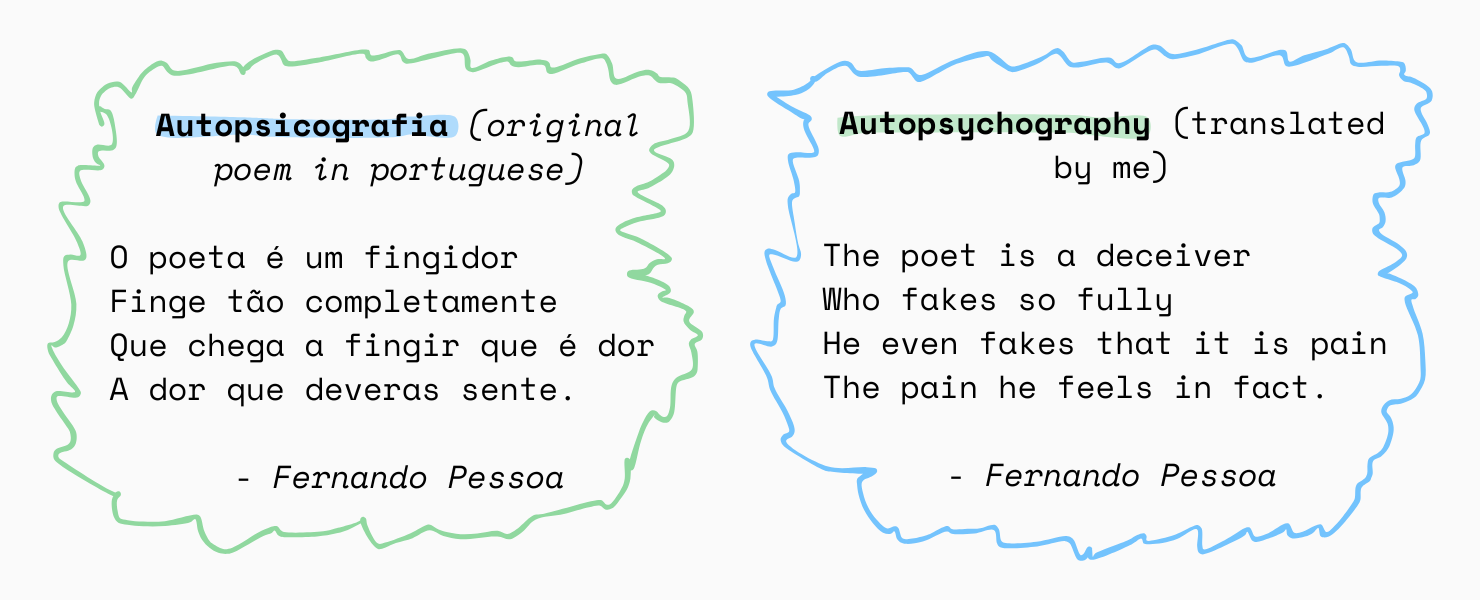
In this excerpt, Portuguese poet Fernando Pessoa highlights how the poet fakes his pain even when he does indeed feel pain. It highlights how art, even when based on true feelings or events, is an exaggeration or revision of truth.

So is the artist a liar?
Ultimately, the role of an artist is to create a truth that the public will feel and believe in, even if just for a few seconds. To do so, the poet must convince the reader that his pain burns like a thousand suns, even if it only prickles like a needle. The painter must make you see the sunny sky even at night. And the actor must incite you to believe that he has died when he laughs happily behind the curtain.
At the end, we must come to terms that the artist must be a liar in the best possible way. It is his only path. And to try to portray the artist as an honest man is tragic.